
Shop Premium Natural Dye Powders Online in India
-
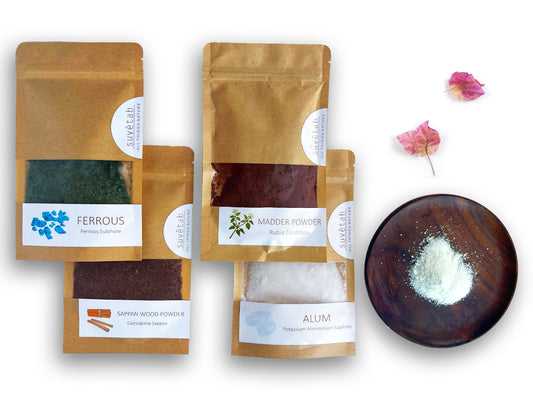
SAPPAN WOOD POWDER
Vendor:Suvetah FashionRegular price From Rs. 55.00 INRRegular price -
MADDER POWDER
Vendor:Suvetah FashionRegular price From Rs. 60.00 INRRegular price -
Catechu Power
Vendor:Suvetah FashionRegular price From Rs. 65.00 INRRegular price -
MYROBALAN POWDER
Vendor:Suvetah FashionRegular price From Rs. 40.00 INRRegular price -
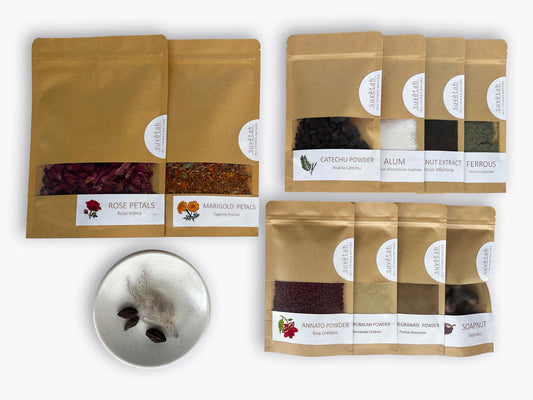
Natural Dyes Ingredients Kit
Vendor:Suvetah FashionRegular price Rs. 990.00 INRRegular price -
POMEGRANATE POWDER
Vendor:Suvetah FashionRegular price From Rs. 45.00 INRRegular price -
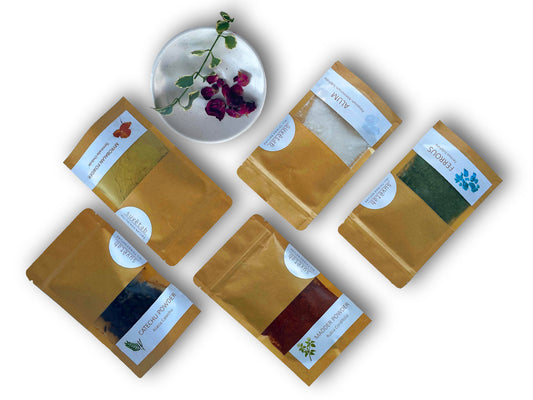
DIY Shades of Petals Kit
Vendor:Suvetah FashionRegular price Rs. 2,399.00 INRRegular price -
DIY Luminous Kit
Vendor:Suvetah FashionRegular price Rs. 2,299.00 INRRegular price





Frequently Asked Questions
What are natural dye powders and how are they different from synthetic dyes?
Natural dye powders are ground or extracted directly from plant sources: roots, bark, fruit rinds, heartwood, and flowers. Synthetic dyes are petrochemical compounds engineered to bond with fiber under industrial conditions. Natural dyes interact with fiber in a way that produces tonal complexity, subtle variation, and a depth of colour that flat synthetic hues rarely match. They are also biodegradable, non-toxic, and safe to handle without protective equipment.
How do I use Suvetah natural dye powders to dye fabric at home?
Start by washing your fabric well to remove any residues that could block dye absorption. Pre-mordant the damp cloth in a warm alum solution for 45 to 60 minutes, then move it into your prepared dye bath. Dissolve the powder into a paste with warm water first before adding it to the pot, heat gently, and keep the fabric moving throughout. The whole process from mordanting to finished cloth can be completed in an afternoon with basic kitchen equipment.
Which mordant should I use with Suvetah dye powders?
Alum is the starting point for most natural dyers because it does not shift colours and works cleanly across cotton, silk, hemp, and wool. If you are working with cellulose fibers like cotton or linen, a tannin pre-treatment using myrobalan or pomegranate powder before the alum step will significantly improve how well the dye bonds. Ferrous sulphate is best used as an after-bath modifier rather than a primary mordant, as it deepens and saddens colours rather than brightening them.
Are Suvetah natural dyes colourfast and wash-fast?
Colourfastness in natural dyeing depends on three things: fiber preparation, mordant quality, and dye concentration. When all three are done correctly, Suvetah's plant-based powders produce results with good wash fastness across repeated gentle washes. The key is not to rush the mordanting stage and to use the recommended powder-to-fabric ratio for the dye you are working with.
What colours can I get using Suvetah natural dye powders?
The range covers a wide palette. Sappan wood produces reds, pinks, and mauves. Madder yields warm red, burnt orange, and dusty rose. Catechu gives you beige through to rich brown. Annatto powder delivers vivid orange and golden yellow. Pomegranate and myrobalan produce soft yellows and yellow-greens. Indigo extract covers the blue end of the spectrum. Combining these, or shifting the pH of your dye bath with modifiers like soda ash or ferrous, opens up a much broader range including purples, olives, and near-blacks.
Are these natural dye powders safe for skin and the environment?
Every powder in the Suvetah range is plant-derived and free from synthetic additives. There are no heavy metals, no azo compounds, and no toxic residues. The dye bath can be disposed of safely without environmental harm. Fabrics dyed with these powders are safe for direct skin contact, including on children's clothing and garments worn close to the body.
How much powder do I need to dye 1 kg of fabric?
The standard measure in natural dyeing is percentage of weight of fiber, usually written as % WOF. For a strong colour on 1 kg of fabric, most powders are used at 20 to 40% WOF, meaning 200 to 400 grams of dye powder. Madder works well at higher percentages, between 40 and 80% WOF, for deep reds. Sappan wood sits comfortably at 20 to 40%.
Can beginners easily use Suvetah natural dye powders?
Natural dyeing has a learning curve, but it is a gentle one. The process follows a consistent logic: prepare the fiber, mordant it, build the dye bath, apply heat, and rinse. Most of it can be done on a stovetop with equipment you already own. Suvetah's range is well suited to beginners because the powders are concentrated, clearly labelled, and work predictably when the basic steps are followed.